A final care order is a court order made under the Children Act 1989 that gives a local authority parental responsibility for a child on a long‑term basis. It is made at the end of care proceedings when the court decides that a child has suffered or is at risk of significant harm and that a care order is necessary.
How a final care order is made
A final care order is made at the conclusion of care proceedings in the Family Court. Proceedings are usually started by the local authority where there are safeguarding concerns about a child’s care.
During the case, the court will consider social work evidence statements from parents, expert assessments and the local authority’s care plan. Interim care orders may be made while investigations and assessments are carried out. The final order is only made once the court has heard all the evidence and decided what long‑term arrangement best protects the child’s welfare.
What does a final care order mean for parental responsibility?
When a final care order is made, parental responsibility is shared between the parents and the local authority. It is not removed from the parents entirely.
In practice, this means the local authority can make key decisions about the child’s care and living arrangements. This may include decisions about:
- Where the child lives
- Schooling and education
- Medical treatment
- Contact arrangements
Parents still retain parental responsibility, but the local authority has the power to override parental decisions where necessary to safeguard the child’s welfare.
The child’s welfare remains the court’s paramount consideration throughout.
Final care order vs interim care order
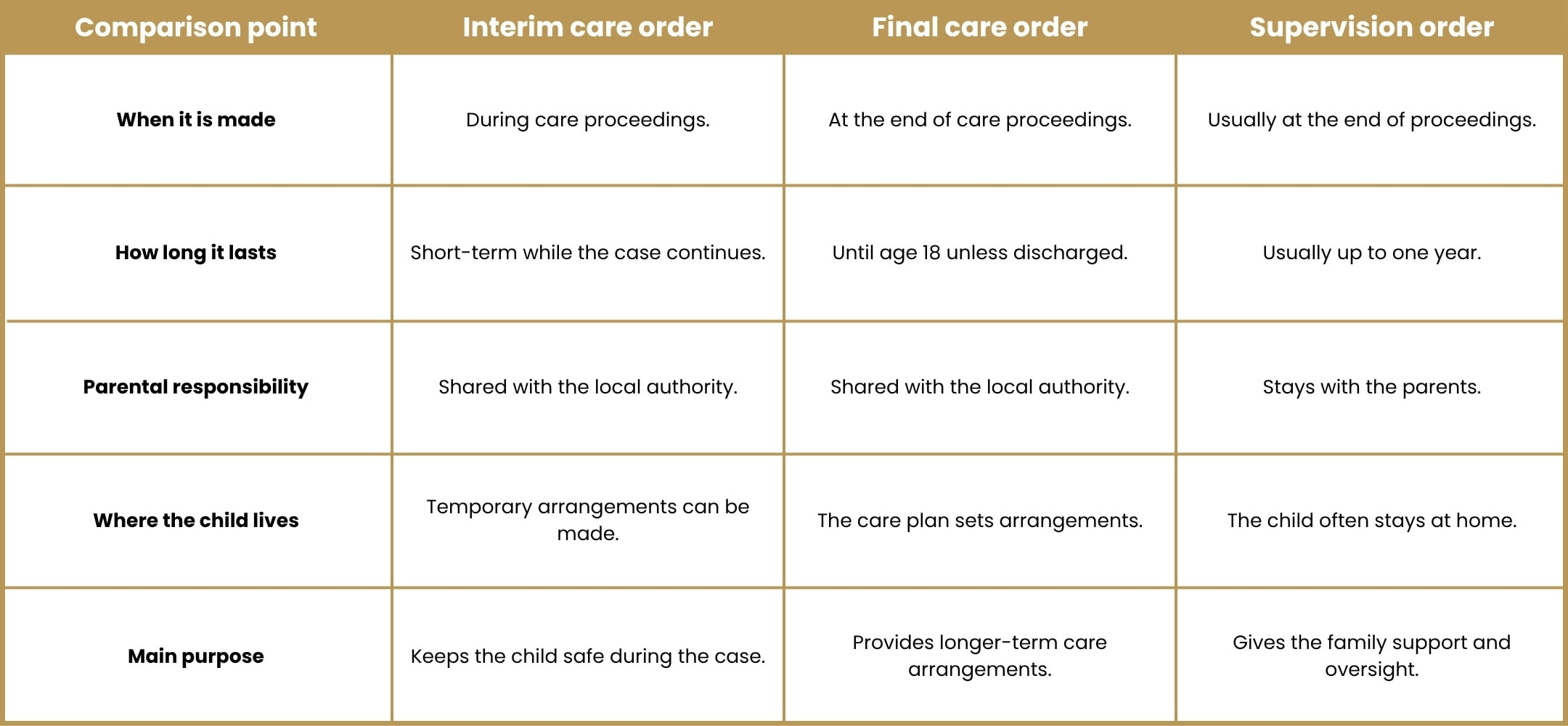
The difference between an interim care order and a final care order is that an interim care order is a temporary measure made while care proceedings are ongoing, whereas a final care order is the court’s final decision about the child’s long-term care.
An interim care order allows the local authority to share parental responsibility while the court gathers evidence, considers assessments and decides whether a final care order or another outcome is appropriate. It does not determine the long-term arrangements for the child.
A final care order is only made once the court has heard all the evidence and concluded that a care order is necessary to safeguard the child’s welfare. It sets the long-term legal framework for the child’s care unless it is discharged by the court.
Final care order vs supervision order
A supervision order is an alternative outcome in care proceedings. Under a supervision order, the child usually remains living at home, and the local authority supervises the child’s welfare.
Unlike a care order, a supervision order does not give the local authority parental responsibility. Instead, it places a duty on the local authority to advise, assist and “befriend” the child, meaning it must provide guidance, support and oversight to help safeguard the child’s welfare.
The court may choose a supervision order rather than a care order where it considers that the child can safely remain with their family with support and monitoring. It is imperative that if a Supervision Order is made that you engage effectively with the Local Authority and undertake any relevant work that has been identified.
Can a final care order be discharged?
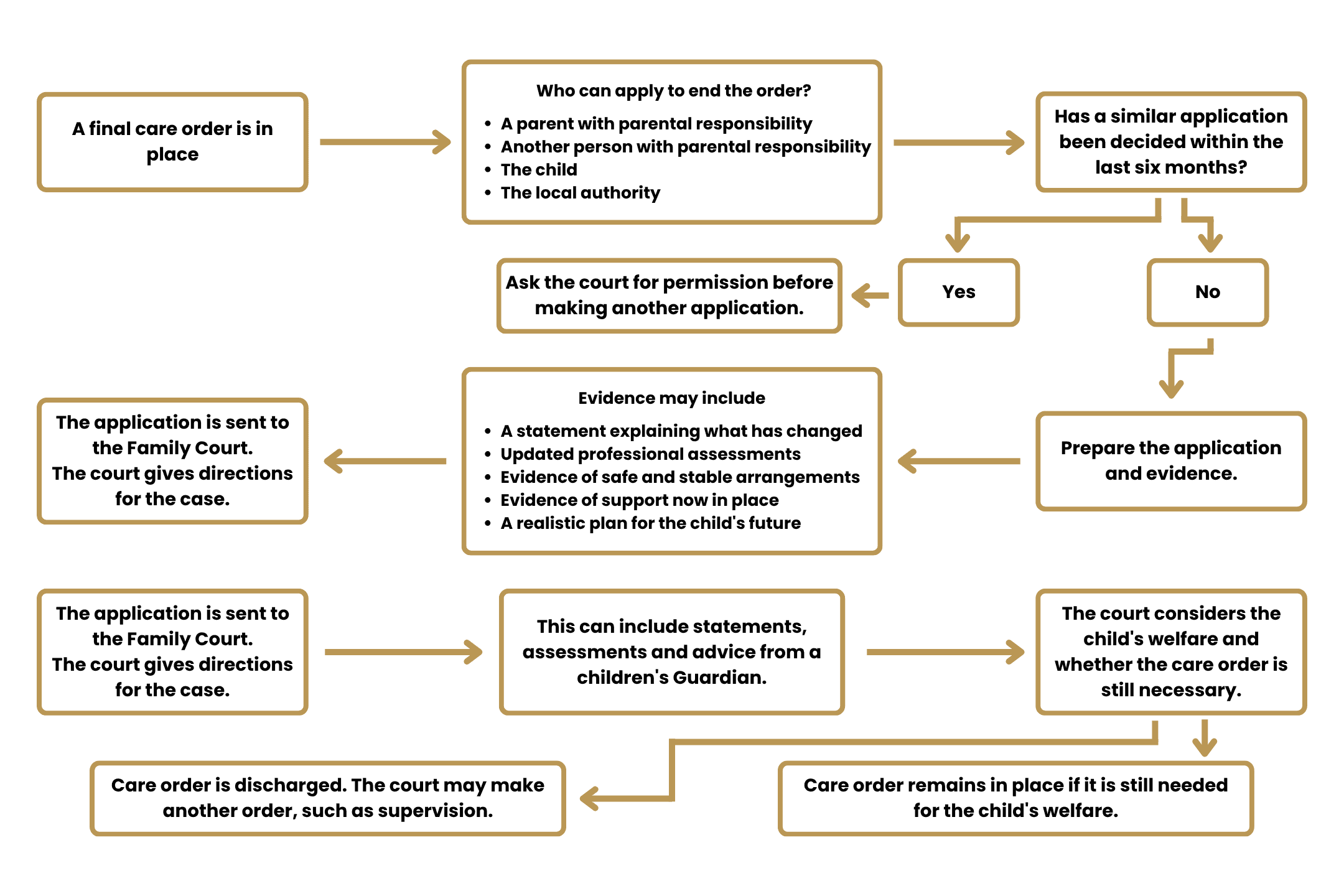
Yes. A final care order can be discharged by the court. An application to discharge can be made by:
- A parent
- The child
- The local authority
Before the court will consider whether to discharge the order, it must be satisfied that there has been a significant change in circumstances since the order was made. This is sometimes referred to as the discharge test. Discharging a care order doesn’t mean a child will return home. Whether this is possible depends on the individual circumstances and the court’s assessment of the child’s welfare
If the court agrees that there has been a sufficient change, it will then consider whether discharging the order would be in the child’s welfare interests.
Evidence in discharge applications may include:
- Updated assessments
- Evidence of stable housing and income
- Completion of recommended courses or support work
- Positive reports from professionals
Discharge applications are considered on the basis of the individual circumstances and the evidence presented. The court will usually give directions for updated statements and, where necessary, fresh assessments before reaching a final decision. As a result, the process can take several months depending on the complexity of the case and the information required.
Where a child is living with relatives under a care order, the court may also consider whether a different long‑term order such as a special guardianship order would better reflect the child’s current circumstances and welfare needs.
What happens after a final care order is made?
Once a final care order is in place, the local authority implements its care plan. This plan sets out how the child’s needs will be met and where they will live.
The local authority’s role typically includes:
- Arranging and reviewing the child’s placement
- Supporting contact between the child and family members
- Reviewing the care plan at regular intervals
Contact arrangements after a care order can vary. The court may make a separate contact order, or contact may be managed through the care plan. If difficulties arise, parents can seek legal advice about how contact is being handled.
A final care order does not automatically end all involvement from parents. Many parents continue to play a role in their child’s life through agreed contact arrangements and the Local Authority will carry out looked-after child reviews in which matters such as contact will be reviewed.
Getting legal advice – legal aid for care proceedings
Decisions made during these cases can have a lasting impact on your child’s future, including where they live, who has parental responsibility, and the arrangements for contact.
Parents involved in care proceedings are usually entitled to non-means-tested legal aid, which means eligibility doesn’t depend on your income or savings. This allows you to receive independent legal advice and representation throughout the court process without having to meet a financial eligibility test.
National Legal Service’s care solicitors represent parents in care proceedings across England and Wales. We can advise you at every stage of the process, from interim hearings through to final care orders, as well as applications to discharge a care order where circumstances have changed.