Stalking is a pattern of unwanted, fixated and obsessive behaviour that is repeated and directed at a person causing distress, alarm or fear. It is a criminal offence in England and Wales under the Protection from Harassment Act 1997, as amended by the Protection of Freedoms Act 2012.
Stalking can have a big impact on your life. You may live in fear about what your stalker will do to you and feel constantly uncomfortable that your stalker will show up unannounced.
In most cases, you will know who your stalker is, but every case is different. In some cases, it can be difficult to recognise stalking, especially where the behaviour has developed gradually or comes from someone you know. Understanding what stalking means can help you identify concerning behaviour and consider the steps that may be available.
What does stalking mean?
Under UK law, stalking involves specific fixated, obsessive, unwanted and repeated behaviours, whereas harassment can be a broader course of conduct. It is a form of harassment that is not limited to following someone in person. It can also involve unwanted contact, online monitoring, false information being shared or someone repeatedly turning up at places they know you will be.
The four warning signs of stalking are when behaviour is fixated, obsessive, unwanted and repeated. If you are experiencing any of the behaviours listed below, you may be being stalked and should report your stalker to the police.
| Step 1: Keep a record | Step 2: Report it | Step 3: Get protection | Step 4: Seek Legal Advice |
|---|---|---|---|
| Keep a detailed log of all incidents, including dates, times, screenshots of all unwanted activity. | If you’re not in immediate danger, contact the police on 101, use online reporting services or visit the station. If you are, call 999. | Explore legal safeguards like Non-Molestation Orders, Stalking Protection Orders, or DAPOs to legally restrict the perpetrator from contacting you. | Speak with a solicitor to guide you through the application process, discuss your civil options, and check whether you qualify for legal aid. |
What counts as stalking?
Stalking can take different forms and may be carried out by a current or former partner, family member, colleague, acquaintance or someone you do not know. The behaviour does not need to involve physical violence to be serious or to be reported.
Examples of behaviour that may amount to stalking include:
- Persistently following you or appearing at places you regularly visit
- Sending unwanted calls, messages, emails or gifts even when asked to stop
- Contacting your friends, family, workplace or children’s school to obtain information about you
- Cyberstalking, where a stalker will check their target’s internet use, emails, texts or other electronic forms of communication
- Identity theft such as creating fake social media accounts or sharing material that claims to be from you
- Waiting outside your home, workplace or another location you visit
- Watching or spying on you
- Interfering with your belongings, vehicle or other property
This however, is not a complete list. The law gives examples of acts associated with stalking, but each situation must be considered in context.
What is the difference between stalking and harassment?
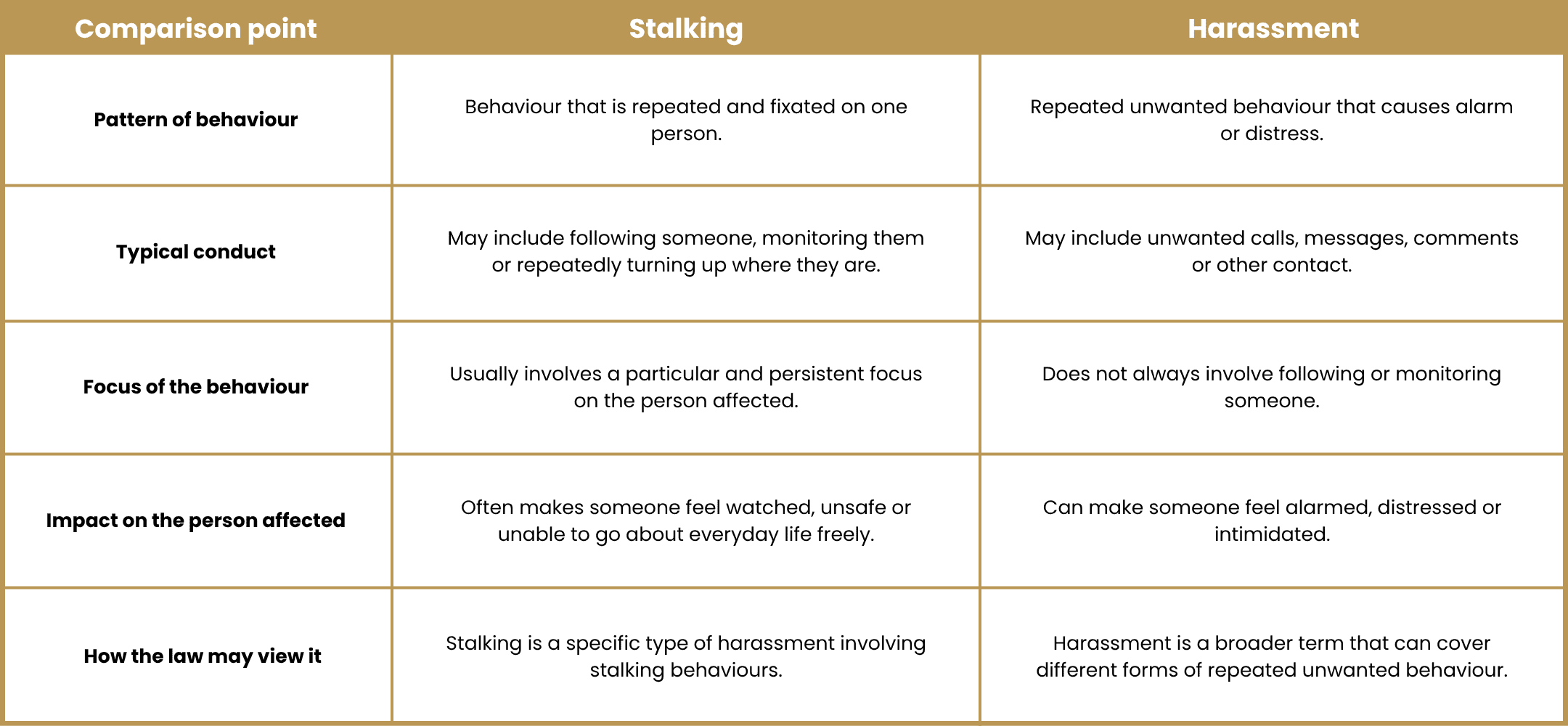
Harassment and stalking are closely linked. Both can involve repeated unwanted behaviour that causes alarm or distress. Stalking is a specific form of harassment that involves a persistent pattern of behaviour directed at a particular person.
For example, repeated unwanted messages may amount to harassment. If those messages form part of a wider pattern of monitoring, following, turning up at places you visit or trying to control contact with you, the behaviour may be stalking. The police and court will consider the full pattern of conduct rather than viewing each incident in isolation.
What is the most common type of stalking?
Not all stalkers are the same. There are different reasons why they begin stalking their victim – some with more sinister motives than others.
Some of the most common types of stalking include:
The rejected stalker: The most common type of stalking. This is where someone will stalk a target as a form of revenge or reconciliation. This is common with former partners.
Intimacy-seeking: Where someone wants an intimate relationship with their target and may have delusions about the nature of the relationship.
Resentment: A stalker who wants to make their target feel uncomfortable due to facing some sort of mistreatment.
Predatory: A stalker who intends to inflict violence or sexually assault their victim.
Incompetent: A stalker who is trying to build a relationship with their target but is doing so in socially incompetent ways.
Is stalking a crime?
Yes. Stalking is a criminal offence in England and Wales. The specific offences are set out in sections 2A and 4A of the Protection from Harassment Act 1997, which were introduced by the Protection of Freedoms Act 2012.
Section 2A covers stalking involving a course of conduct that amounts to harassment. Section 4A is the more serious offence where the conduct causes someone to fear that violence will be used against them on at least two occasions, or causes serious alarm or distress which has a substantial adverse effect on their usual day-to-day activities.
You don’t need to decide for yourself whether the legal test has been met before asking for help. If repeated behaviour is making you feel unsafe, controlled or unable to live your life as normal, you can report it to the police.
What to do if you’re being stalked
If you’re being stalked, it’s important to know that it is never your fault. No one deserves to feel uncomfortable living their life. You can rely on the legal system to protect you if you do feel unsafe due to a stalker.
If you are in immediate danger and believe that your stalker is an imminent threat to your safety, call the police on 999.
If you are not in immediate danger, you can still report your stalker to the police by reporting through online reporting services, calling 101 which is the non-emergency hotline and is staffed 24/7, or you can visit your local police station to speak to an officer in person.
You may also wish to consider practical safety steps, such as reviewing privacy settings on social media, telling a trusted person what is happening and speaking to your workplace or child’s school where this feels appropriate and safe.
What legal protections may be available?
The right legal option depends on the circumstances, the relationship between the people involved and whether police action is taking place. A solicitor can explain the available routes and help you understand which may be appropriate.
A Non-Molestation Order is a civil protective option where stalking or harassment is connected to domestic abuse by a current or former partner or another person with whom you are legally associated. This order can place legal restrictions on a person’s behaviour, including contact, threats, harassment or abuse. It doesn’t guarantee safety, so practical safety planning and urgent police help remain important where there is immediate danger.
A Stalking Protection Order is different. It is an order the police can apply for through the magistrates’ court where they believe a person has carried out acts associated with stalking, poses a risk associated with stalking and an order is necessary to protect another person. A criminal conviction is not required before the police apply.
A Domestic Abuse Protection Order (DAPO) may also be relevant where stalking forms part of domestic abuse. These orders are currently available only in specified pilot areas, so availability depends on the circumstances and location of the person alleged to have carried out the abuse.
Legal support for stalking linked to domestic abuse
Stalking by a current or former partner can be part of a wider pattern of domestic abuse, including controlling or coercive behaviour. Domestic abuse is not limited to physical violence. It can also include stalking, harassment, threats, intimidation, controlling behaviour and other forms of abuse. It is important to take concerns seriously, even where the behaviour does not involve physical violence.
National Legal Service Solicitors can advise on family law protections such as non-molestation orders where the legal requirements are met. A solicitor can explain the process, discuss practical options and help you understand whether legal aid may be available.